
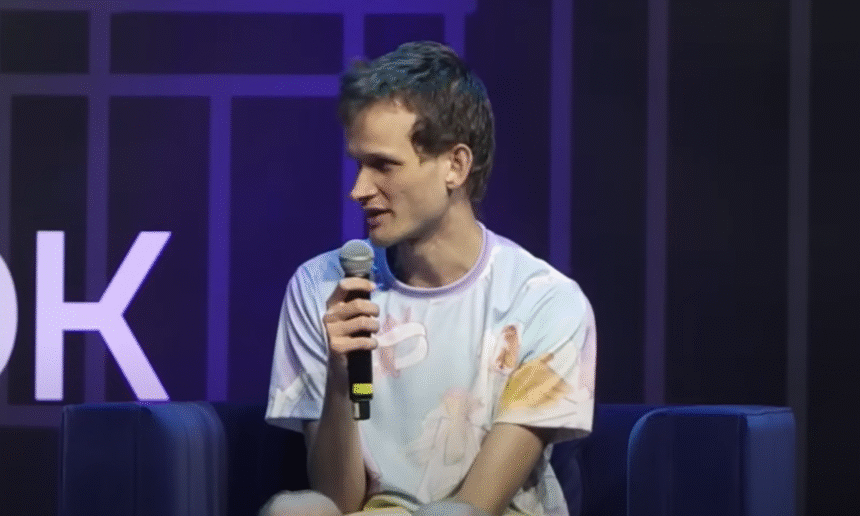
Ethereum co-founder Vitalik Buterin drew attention in 2026 by reverting his X profile picture to a Milady-style avatar and pairing it with manifesto-like posts that re-centered Ethereum’s identity around a single, time-honored ambition: to become the “world computer” for an open internet.
“Welcome to 2026! Milady is back,” Buterin wrote, before going on to spell out what he envisioned as Ethereum’s 2025 advancements: higher gas limits, increased blob counts, improved node software quality, and the achievement of major performance milestones for zkEVM. He also claimed that “with zkEVM and PeerDAS, Ethereum has taken its biggest step towards a fundamentally new and more powerful kind of blockchain.”
Ethereum needs to bring computers to the world
However, the post’s center of gravity was not a victory lap. It was a warning that the network had not yet achieved the goals it had set for itself, and that chasing the currently hot stories wasn’t important.
Buterin drew a clear line between Ethereum’s long-term mission and the trend-driven incentives that often dominate cryptocurrency cycles. “Ethereum needs to work harder to achieve the goals it has set for itself,” he wrote. “Whether it’s tokenized dollars or political meme coins, it’s not a quest to ‘win the next meta’ or arbitrarily persuade people to help fill block space to create ETH ultrasounds again, it’s a mission to build a world computer that will serve as the central infrastructure of a freer and more open internet.”
From there, he explained what “world computer” actually means. It is a decentralized application that cannot be quietly changed or stopped and remains available even if the enterprise or infrastructure that most users take for granted fails.
“We are building decentralized applications. Applications that run without fraud, censorship, or third-party interference,” he wrote. “An application that passes the walk-away test will continue to run even if the original developer is no longer around. It’s an application that users wouldn’t even notice if Cloudflare went down or if Cloudflare were all hacked by North Korea.”
Buterin extended similar expectations beyond finance to explicit name-checking of identity, governance, and “other civilized infrastructure that people want to build,” emphasizing that privacy is a core asset, not a nice-to-have.
What’s notable about this post is that Buterin refuses to treat usability and decentralization at scale as trade-offs that Ethereum can punt. “To achieve this, it needs to (i) be easy to use and be used at scale, and (ii) be truly decentralized,” he said, arguing that these requirements apply to both the base layer and the application layer, “including the software used to run and communicate with the blockchain.”
This framework implicitly puts pressure on multiple stakeholders simultaneously: core protocol work, client diversity and quality, infrastructure that is not concentrated around a few providers, and a dapp architecture that can meet user expectations while also withstanding developer abandonment.
Buterin concluded with a statement of resolve rather than specifics, saying that Ethereum has a “powerful tool” but needs to be applied more aggressively. “All of these areas need to improve. They have already improved, but they need to improve even more,” he wrote. “Fortunately, we have powerful tools, but we must and will apply them.”
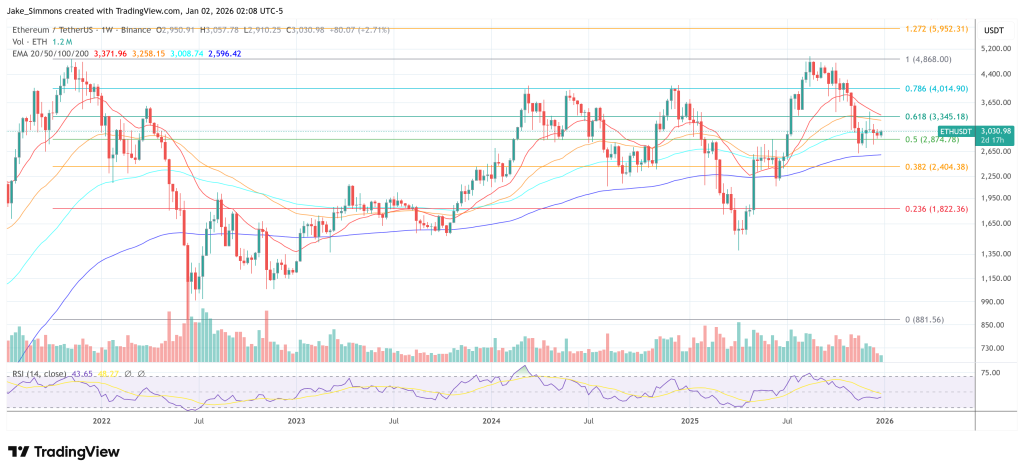
At the time of writing, ETH was trading at $3,030.
Featured image from YouTube, chart from TradingView.com