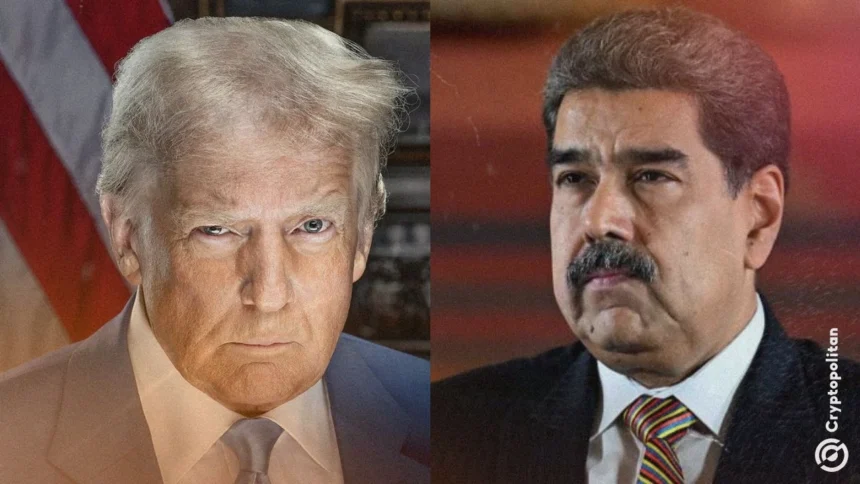

Analysts and economists specializing in politics, oil, cryptocurrencies and risk say President Trump and the situation in Venezuela are not expected to have a significant impact on the global economy or financial markets when trading floors open Sunday night.
Indeed, the invasion of Venezuela is certainly a very big problem. That’s because Washington hasn’t taken this kind of direct action in Latin America since the 1989 invasion of Panama, which removed military leader Manuel Noriega under similar allegations.
And Cryptopolitan earlier reported that President Trump told reporters at a post-mortem press conference that the US would run. Venezuela Secretary of State Marco Rubio will review the details, he added.
Around the same time, President Trump warned that the United States could intervene to help Iranian protesters if security forces opened fire, as the violence there has left several people dead and created the most serious domestic challenge for Iranian authorities in years.
Oil markets and investors remain stable despite massive geopolitical uncertainty
Of course, the market’s attention remains on energy, not stocks or cryptocurrencies. OPEC+, which includes Venezuela and Russia, is expected to meet in the next few hours to discuss production levels.
Jamie Cox, managing partner at Harris Financial Group in Richmond, Va., said the overall market response has been limited. “Overall market reaction will be muted. There may be some market-moving news at tomorrow’s OPEC meeting,” Jamie said.
He added that talks about rebuilding Venezuela’s oil industry could generate interest in stocks of major oil companies and drillers.
The scale of the turnaround will be large, said Helima Croft, head of global commodity strategy and MENA research at RBC Capital Markets in New York.
“This is a major undertaking, given the decades-long decline of the oil sector, and the United States’ record of regime change and nation-building is not one of clear success,” Herima said.
Brian Jacobsen, chief economic strategist at Annex Wealth Management in Brookfield, Wis., said the situation was expected.
Brian added that from an investor’s perspective, large oil reserves could become available over time. He also said the move sends a signal to the Iranian and possibly Russian leadership about President Trump’s willingness to act.
“Markets can go into risk-off mode due to the expectation of conflict, but once conflict starts they quickly switch to risk-on mode,” Bryan said, adding that the only market to react could be oil, especially with forecasts already pointing to oversupply.
Venezuela also grapples with years of oil decline and legal disputes
Economists say geopolitical pressures are already part of everyday transactions. Markel Aleksandrovich, an economist at Saltmarsh Economics in London, said current events were exacerbating existing tensions.
“From unresolved trade tensions over U.S. tariffs to Ukraine, Iran, Taiwan, and now Venezuela, it’s clear that markets will have to contend with even greater headline risks,” Marchel said. said.
Tina Fordham, founder and geopolitical strategist at Fordham Global Foresight in London, said optimism often emerges early. “I feel like there’s a lot of optimism about a post-Maduro, post-Chavez Venezuela. I think the reality is likely to be much more troublesome,” Tina said.
He added that Monday’s market opening could stimulate risk appetite related to possible changes in Iran. “We have seen these protests regularly, and this time they have increased in intensity,” Tina said, noting that both Iran and Venezuela are energy producers and consumer markets that remain closed to global investors.
The country has some of the world’s largest estimated oil reserves, but production has been in decline for decades due to mismanagement and loss of foreign investment after oil nationalization in the 2000s, including assets related to Exxon Mobil and ConocoPhillips.
Chevron remains the only major U.S. company operating in Venezuela. ConocoPhillips is seeking billions of dollars related to three projects that were foreclosed on nearly 20 years ago, while Exxon continues to pursue long-term arbitration after its exit.
The oil tanker chartered by Chevron was one of the few vessels to leave Venezuela in recent weeks after President Trump’s December blockade announcement, as reported by Cryptopolitan.
Join Bybit now Claim your $50 bonus in minutes