
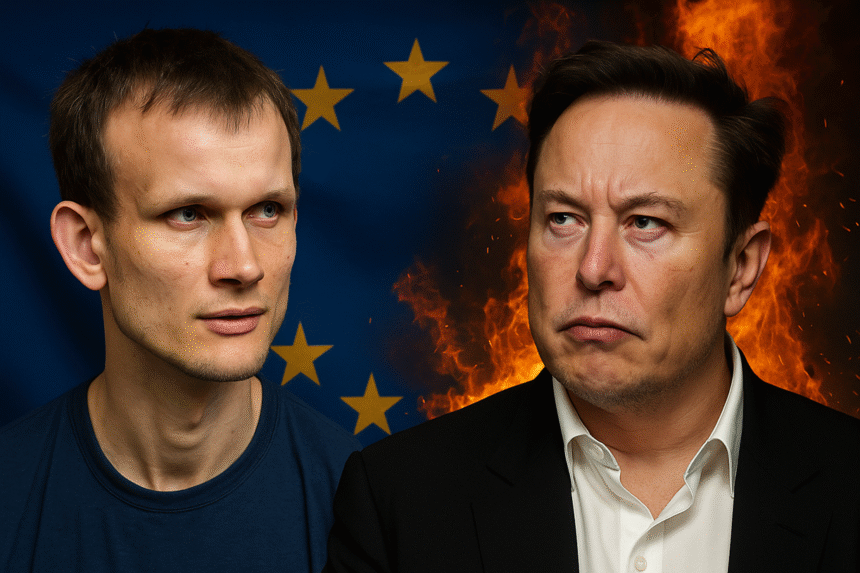
Ethereum founder Vitalik Buterin has issued a sharp public warning to Elon Musk about how X is being used to foment increasingly aggressive rhetoric in Europe, claiming the platform is drifting away from ideals of free speech and toward organized hostility.
Ethereum founder criticizes Elon Musk
In a series of posts about X, Buterin said: “The attacks on Europe that we’ve seen here over the last few days are starting to go unchecked, including from people who I generally thought were interesting and sophisticated.”
He acknowledged that the European Union has serious shortcomings: “The GDPR click-through is stupid, the chat controls are terrible, we need to be less bureaucratic and support entrepreneurs,” and criticized what he called Europe’s selective moral stance, noting that the EU’s “kindness towards Ukraine often doesn’t translate well to Gaza, Sudan and other places.” He also called “people who say mean things about criminals getting longer sentences than criminals” as “just crazy.”
Nevertheless, the Ethereum founder argued that the way some X users are talking about Europe goes far beyond legitimate criticism. He called the “apocalyptic attitude towards this issue, evoking images of barbarians plundering Rome and elsewhere” as “truly over the top” and said it “feels more like a coordinated attempt to delegitimize than constructive criticism”.
He rejected the idea that the only real targets were institutions based in Brussels, writing: “I don’t believe in saying, ‘It’s not Europe, it’s the EU.’ I’ve seen many instances where London has been targeted, especially in hate sessions, so no, most of them are attacks on Europe.” This, he claimed, was inconsistent with his own experience of “spending an average of two months there every year for the past 10 years.”
The central conflict came in direct response to Mr. Musk. Referring to X owners’ self-positioning as defenders of free speech, the Ethereum founder wrote: “I think we should consider that making X a global totem pole for free speech and then turning it into a Death Star laser for organized hate sessions is actually detrimental to the free speech cause. I seriously worry that a major backlash against the values I hold dear is coming in the years ahead.”
Buterin hints at Russian involvement
The thread sparked a backlash from some users who argued that his remarks underestimated European complicity in the current conflict. One critic responded, “‘Not being kind’ is an incredible way to frame the funding, arming, and political support of genocide,” and argued, “It’s laughable to think that the United States hasn’t suffered many of the same or worse things that Americans say about the EU.”
The Ethereum founder responded that Europe is “really mixed,” stressing that “different countries in Europe have very different policies,” and noting that the continent is “also home to the ICC, which is under tremendous pressure” (see: Economic Weakening of Judges).
Other replies broadened my perspective on geopolitics. Asked about the suggestion that the current discourse looks like “a coordinated campaign by the Kremlin to like America’s new ‘return to Monroe’ global security policy,” Buterin responded, “Basically yes,” adding that “a lot of people in power really like the vision that the world should be just five to 20 adults with their own domains, who should get together in the same room sometimes to discuss their differences, and shut others out because they’re a nuisance and an inconvenience.”
At the same time, Buterin reiterated his support for the European project as an institutional experiment. “I have great respect for the idea of the EU as an experiment in reaping supranational benefits without homogenization, becoming an aggressive ‘great power’ and other downsides,” he said, but added: “This experiment needs to be adjusted in many ways. For example, we see that there is not enough unity in foreign policy, and at the same time there is too much uniformity in top-down bureaucracy and oversight.” If improved, he argued, “this is a model that can set a really good example to the world.”
On the technical side, Ethereum founders used the discussion around “GDPR clickthrough” to propose a different approach to online control, calling for “more sophisticated user-side software (browsers, local LLM, etc.) that helps users navigate the internet and make intelligent decisions about what requires confirmation from the user.” In contrast to the centralized mechanisms he criticizes for X, he effectively points to decentralized tools that empower users as a way to reconcile regulation, ease of use, and freedom of expression.
Masks vs. European Union
Notably, Mr. Musk’s anti-EU outburst came after the European Commission imposed a €120 million fine on Company X for breaching its transparency obligations under the Digital Services Act (DSA). “The EU imposed this insane fine not only on @X, but on me personally. This is even more insane!” Musk wrote via X. “It is appropriate that our response extends not only to the EU, but also to the individuals who have taken this action against me.”
Subsequent posts escalated further, declaring that “the EU should be abolished and sovereignty returned to each country,” calling for “dissolving the EU and returning power to the people,” and even claiming that “the EU People’s Commissar is responsible for the murder of Europe.”
At the time of writing, Ethereum was trading at $3,316.
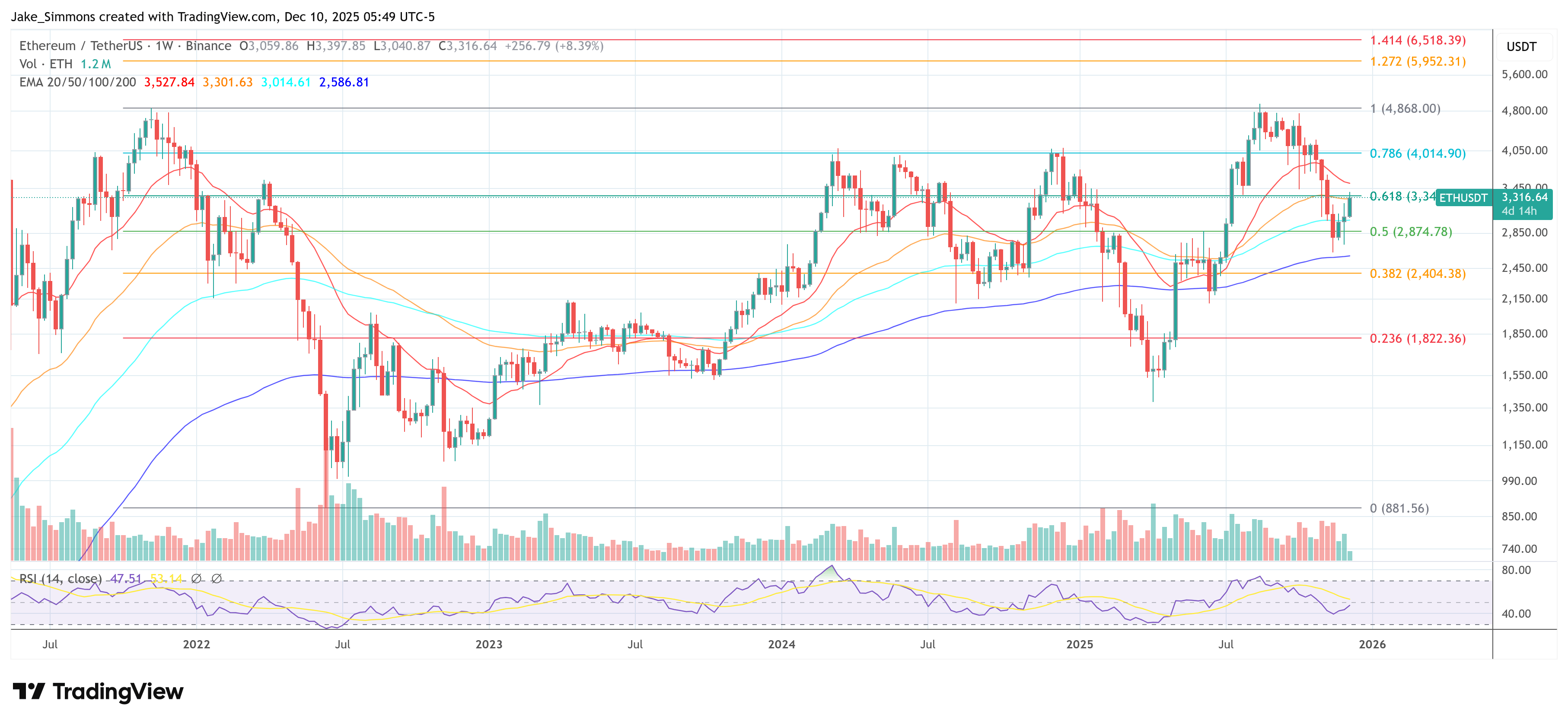
Featured image created with DALL.E, chart on TradingView.com