

The first weeks of the year have not been kind to markets, with Ethereum (ETH) entering 2026 with a mixed story that reflects both progress and restraint. Meanwhile, networks have broken through long-standing technological limitations and become more widely used in the real world.
Meanwhile, market data shows continued selling pressure, which is keeping price movements subdued. Taken together, these trends suggest that Ethereum is less in decline than in transition, balancing structural growth against a cautious market environment.
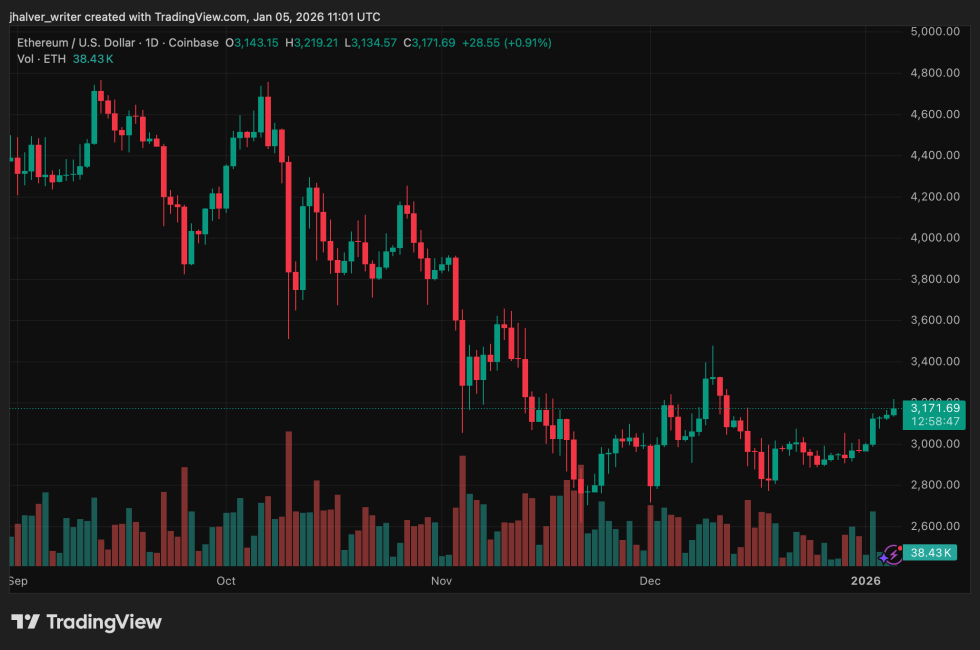
ETH's price trends slightly to the upside on the daily chart. Source: ETHUSD on Tradingview
Technology advancements and network upgrades
Recent comments from Ethereum co-founder Vitalik Buterin have brought renewed attention to the evolution of the blockchain trilemma: the challenge of balancing decentralization, security, and scalability.
According to Buterin, upgrades such as Peer Data Availability Sampling (PeerDAS) and Zero-Knowledge Ethereum Virtual Machine (zkEVM) have moved this goal from theory to reality on the mainnet.
Introduced in the December Fusaka upgrade, PeerDAS eases the burden on validators by allowing them to verify data availability through sampling rather than processing the complete dataset. This increases scalability while maintaining accessibility to participation.
At the same time, zkEVM has reached an early stage of operation, with significantly reduced proof generation time and significantly lower verification costs. Although these systems are still in alpha, they are expected to take on a larger verification role from 2027 to 2030 with further security enhancements.
In addition to performance improvements, Ethereum’s roadmap has shifted to a focus on protocol security. The Ethereum Foundation has set a goal of achieving 128 bits of provable security by late 2026. This shows that recent improvements in speed and cost are increasingly being matched with increasingly stringent security objectives.
Ethereum (ETH) adoption moves towards practicality
Beyond core protocol work, Ethereum usage metrics show growing adoption. Stablecoin transfer volume on the network exceeded $8 trillion in Q4 2025, nearly doubling since the beginning of the year.
Active addresses and daily transactions also reached record levels, reinforcing Ethereum’s role as the primary settlement layer for payments and tokenized assets.
Industry observers are increasingly pointing to crypto-native neobanks as a key growth driver in 2026. These platforms combine self-custody, stablecoins, and yield products with familiar banking interfaces, lowering the barrier for mainstream users.
Looking ahead to 2025, institutional participation, particularly through digital asset treasury and staking-related structures, has helped lay the foundation for a shift towards everyday financial use rather than short-term transactions.
Market pressure and developer momentum
Despite these developments, market flow data shows that Ethereum remains under dominant selling pressure, reflecting widespread risk aversion across crypto assets. This limited upside room and led to volatile price movements, despite the emergence of a positive narrative.
Similarly, developer activity tells a different story. An estimated 8.7 million smart contracts were deployed in the fourth quarter of 2025, the highest number ever for a quarter.
Taken together, Ethereum’s current signals point to consolidation rather than contraction. While market conditions continue to pressure prices, technological advancements and increased adoption indicate the network is poised for the next phase of growth once broader pressures ease.
Cover image from ChatGPT, ETHUSD chart from Tradingview