

Ethereum fell below the $3,200 level following the Federal Reserve’s decision to cut interest rates by 25 basis points, which initially caused volatility across the cryptocurrency market. While many expected a stronger reaction for Ethereum, the asset instead declined as traders reassessed the macro environment and the impact of a potential shift towards stagflation. Despite this backlash, on-chain data suggests that the underlying market structure may be quietly improving.
According to new insights from CryptoQuant, Ethereum’s net taker volume (30-day moving average) shows a clear upward trend from its lows. This indicator tracks the balance of active buyers and sellers in the derivatives market. Although ETH remains under selling pressure, data reveals that the intensity of the aggressive selling has steadily weakened over the past few weeks. Each subsequent negative low has formed higher than the previous low, indicating that sellers are losing their advantage.
Although overall sentiment remains cautious, a subtle improvement in net taker volume suggests that ETH’s current weakness may be masking the early stages of a larger structural shift.
Net taker volume suggests possible structural change
According to CryptoQuant’s CoinCare, Ethereum may once again be approaching a critical tipping point. The report highlights that a similar net-taker volume structure emerged earlier this year. After forming a clear bottom in January 2025, the indicator turned to an upward trend while remaining in the negative zone, indicating that active sellers are gradually losing their strength.

By April, net taker volume had decisively turned into positive territory. From that very moment, Ethereum entered one of the most powerful bull markets of the cycle, more than tripling to new all-time highs.
The current situation reflects the same pattern. Since the peak of selling pressure in September, the market has been absorbing selling flow continuously for almost three months. Each negative low in net taker volume has formed higher than the previous, revealing the market’s increasing resiliency despite the broader downtrend. If this trajectory holds, Coincare estimates that we could be only about a month away from net taker volume turning positive.
Historically, this negative to positive transition marked the beginning of Ethereum’s most explosive breakout phase. If a rise into positive territory is confirmed, it would likely trigger the next economic expansion towards new all-time highs, suggesting that momentum is quietly rebuilding behind the scenes.
ETH weekly structure attempts recovery
Ethereum’s weekly chart shows that the market is trying to stabilize after several weeks of volatility, with the price currently trading around $3,195 following a strong rebound from the $2,800 zone. The region acted as a major demand area in mid-2024, once again providing support and preventing a severe collapse. Recent weekly candlesticks reflect renewed buying interest, ending firmly above the 50-week moving average, a level that often defines medium-term trend direction.
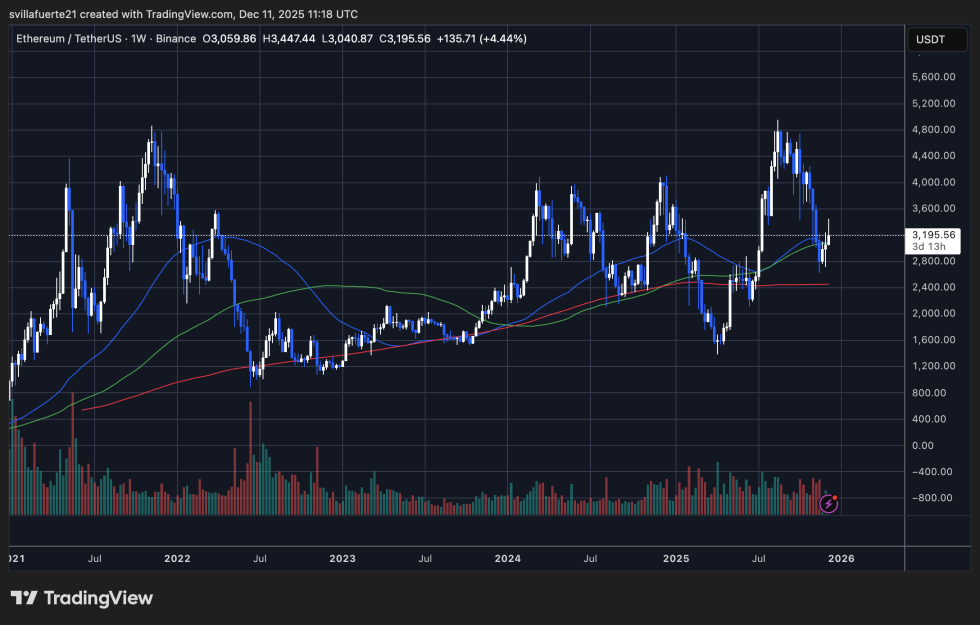
Despite this recovery, ETH still faces structural challenges. The 100-week moving average (now overhead) has been acting as a resistance level throughout the current downtrend, and the price rejected it again with the recent rally towards $3,447. Until Ethereum can confidently reclaim this dynamic resistance, the broader trend will remain neutral to slightly bearish.
There is also a noticeable change in volume. While activity on the seller side has decreased over the past month, buyers have begun to intervene more actively at key support levels. This is consistent with improvement in on-chain indicators and suggests weakening selling pressure.
The next major objective for the bulls is a weekly close above $3,400, which would signal a possible trend reversal. However, if this level is not broken, there is a risk of a retest of $2,900-$2,800, which will test market sentiment again.
Featured image from ChatGPT, chart from TradingView.com