Bitcoin has been struggling below the $90,000 level since last week, but is now looking to stabilize as selling pressure continues to shape market sentiment. The sharp decline from recent cycle highs has put bullish traders on the defensive and reduced confidence across spot and derivatives markets. Analysts who were predicting a continuation to new all-time highs just a few weeks ago have now changed their tune, with many calling for the beginning of a bear market.
Related books
These concerns are further amplified by the broader market environment. Momentum has declined, liquidity has thinned, and buyers have not been able to regain key resistance levels that indicate strength. As Bitcoin searches for support, investors are now watching the reaction around the high $80,000 level to determine whether this decline is part of a deeper structural reversal or a temporary correction within a larger trend.
According to top analyst Axel Adler, long-term holders are playing a crucial role in the current economic downturn. He reports that this group performed the largest profit-taking event of the entire cycle, resulting in lower profits. position The price fell towards $80,000, increasing by 1.57 million BTC in the quarter. This distribution size has historically been consistent with depletion phases and late-cycle peaks, fueling speculation that Bitcoin may be entering a more prolonged downturn.
Distribution of long-term holders suggests major cycle shift
axel adler highlights Large-scale profit-taking by long-term holders (LTH) is pushing supply levels back to their lowest levels in early 2023. According to his data, the 30-day net position change reflects one of the deepest declines seen during the entire bull cycle. LTH supply has declined sharply from its peak of 15.75 million BTC to the current 13.6 million BTC, the lowest level since the beginning of the cycle. Adler points out that this pattern is consistent with the classic smart money distribution phase often seen near the top of major markets.
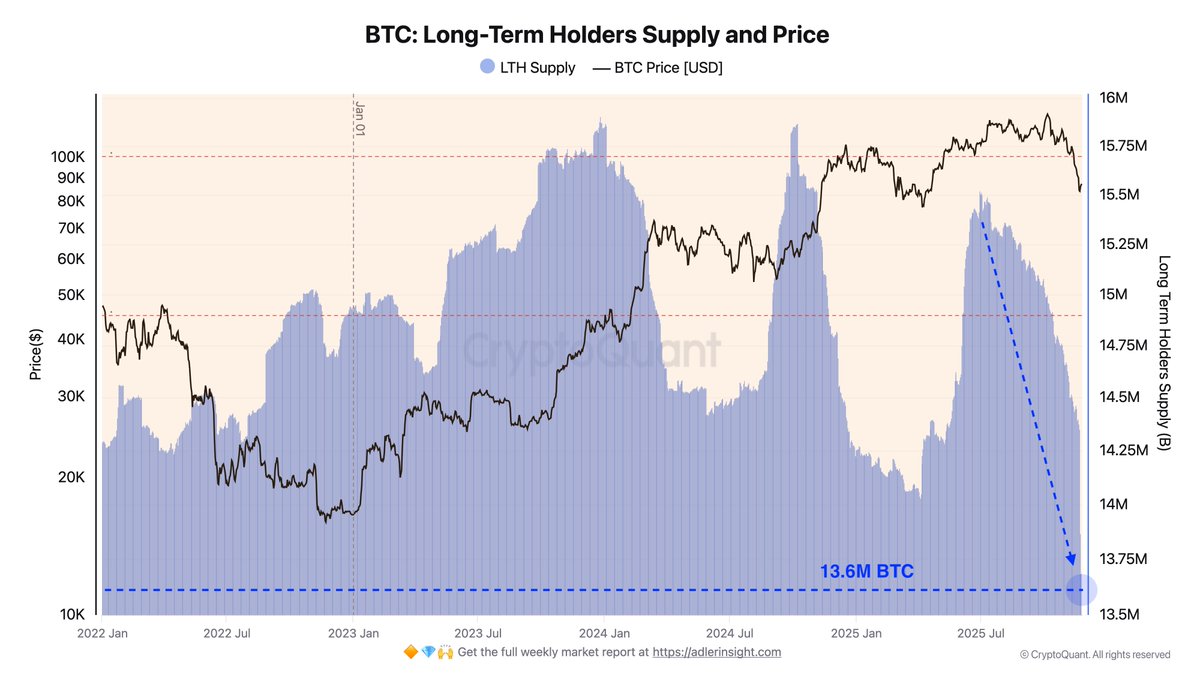
In the past two weeks alone (November 11-25), LTH sold 803,399 BTC. This corresponds to a decline of 5.54% and an average of 53,560 BTC per day. Historically, such supply compression occurred only during major inflection periods.
Adler compares the current reading to previous extremes: March 2024, after the all-time high drop of $73,000, and October 2024, when Bitcoin corrected towards $85,000 from its ATH. At the current stage, aggressive coin dumping is indicated, with the red bar of net position change becoming deeply negative, and at the same time the price has fallen from its October peak.
This combination of rapidly decreasing supply and falling prices suggests that LTH distribution is putting significant pressure on the market. This data suggests that the cycle may be moving into a structurally weak phase unless new demand comes in again to absorb the sell-side volume.
Related books
BTC tries to stabilize after sharp drop
Bitcoin price action on the daily chart shows that the market is struggling to regain its footing after plummeting from around $120,000 to recent lows around $80,000. Current trading levels around $86,800 reflect a rebound on the bailout, but the overall trend remains clearly bearish.
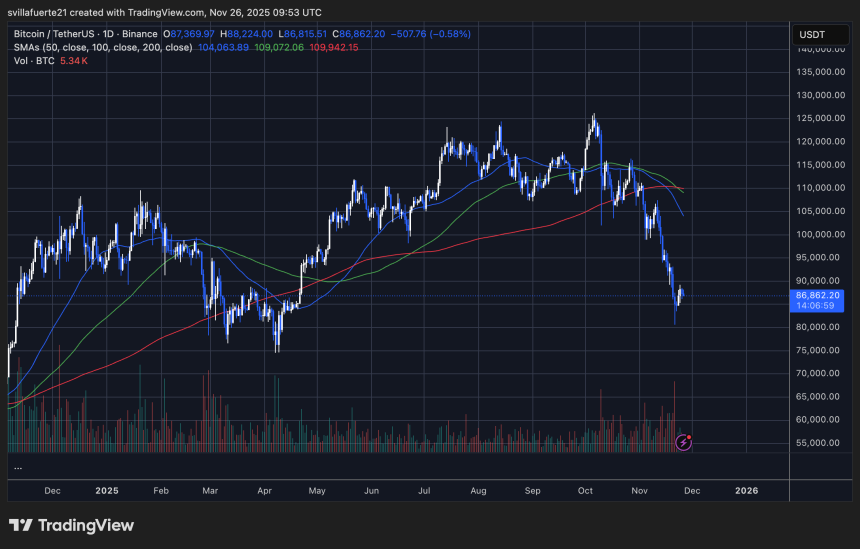
Price is below its 50-day, 100-day, and 200-day moving averages, all of which are currently tilted to the downside, a structure that typically indicates continued downside momentum. The rejection from the breakdown zone in mid-November reinforces the idea that former support has turned into resistance.
Related books
The spike in volume during the decline indicates forced liquidations and capitulation-driven selling rather than orderly distribution, but the recent rally has occurred on significantly lighter volume, suggesting weaker buyer conviction.
The key focus for bulls is whether Bitcoin can build a foundation above the $85,000 area to avoid another wave of selling pressure. A loss of this level could expose further downside towards $78,000 and even $72,000.
Featured image from ChatGPT, chart from TradingView.com