

Ethereum (ETH), the largest smart contract platform, has successfully activated the Fulu-OSAKA hard fork. With all the attention focused on optimizing Peer Data Availability Sampling (PeerDAS), EIP 7825 “Transaction Gas Limit Cap” may have been greatly overlooked. This is why it is so important for Ethereum (ETH) to maintain scalability in the ZK era.
EIP 7825 makes Ethereum (ETH) scalable, predictable, and performative: Opinion
Michael Dong, co-founder of Brevis ZK Coprocessor, said in X that EIP 7825 is one of the most underrated upgrades for the future of ZK proofs and 100x Ethereum scaling. EIP 7825 reduces the risk of a single “megatransaction” consuming the entire computational power of an Ethereum (ETH) block.
EIP-7825 is one of the most underrated upgrades to the future of ZK proofing and 100X Ethereum scaling.
By capping each Ethereum transaction at a maximum of 16.78 million gas, we eliminate the risk of a single “megatransaction” consuming an entire block. It sounds like a small thing, but the impact is… https://t.co/XxvOorrT0S
— Michael (@no89thkey) December 3, 2025
EIP 7825 imposes a gas cap of 30 million gas per transaction. Ethereum (ETH) transactions cannot spend more gas on validation. Before Fusaka, large transactions could consume excessive resources and increase potential latency.
It was also dangerous for ZK to prove that no zero-knowledge system could predict how Ethereum (ETH) would handle this “unparalleled unit of work,” as Dong explained.
This would eliminate the opportunity to prove transactions on Ethereum (ETH) in real time, which was completely unacceptable for the goal of “100x Ethereum scaling.”
But now that gas spending per block is predictable and limited to a single transaction, the ZK proof system will be predictable as well. In a worst-case scenario with maximum post-fusaka transactions, Brevis co-founders estimate that the entire proofing step will take less than 5 seconds.
Fusaka activation completed smoothly despite the bug
As a result, the associated parallel computing power already allows the ZK system to regularly verify between 100 and 200 million gas blocks, which is fully in line with the real-time proof goals of Ethereum (ETH)’s ZK roadmap.
As previously covered on U.Today, Ethereum (ETH)’s fusaka upgrade was activated on December 3, 2025, as predicted. This revamped data logistics and increased the number of blobs that Ethereum (ETH) can process in each block.
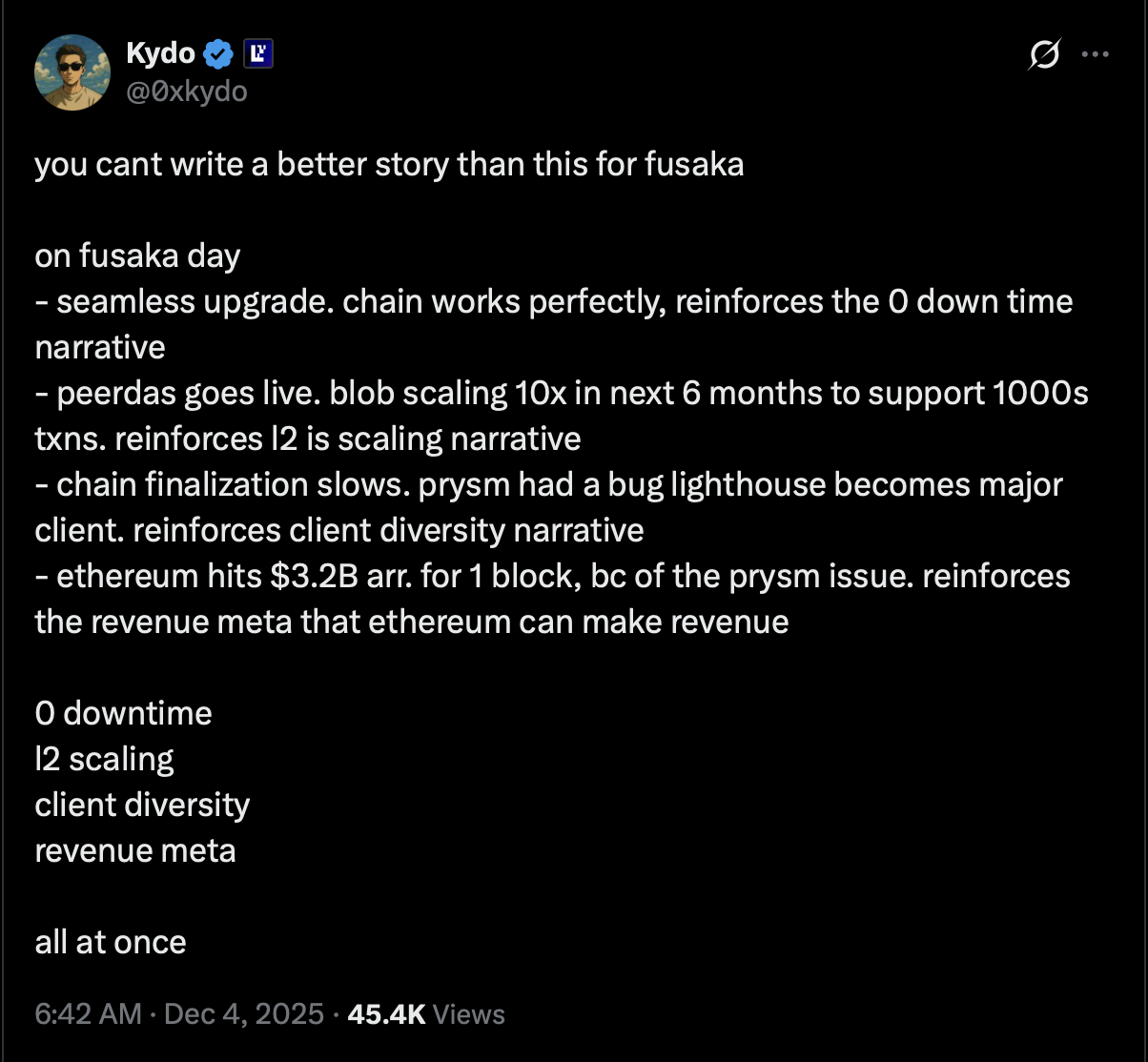
Despite the bugs found in Prysm, the upgrade activated as intended and Lighthouse became the dominant client. As researchers found, the activation process resulted in zero downtime and reinforced the need for client diversity.