

table of contents
What is LitVM? Understanding the technical architecture What is the rollout strategy and timeline? How will LitVM evolve Litecoin use cases? Conclusion FAQ
litecoinwas created by Charlie Lee in 2011 and began as a faster, more affordable alternative. BitcoinScrypt’s proof-of-work system provides block times of 2.5 minutes and fees often less than 1 cent.
Over the years, we’ve built a reputation for reliable payments, integrating with services like BitPay and Travala. We also adopted upgrades such as Segregated Witness in 2017 to improve scalability and MimbleWimble Extension Blocks in 2022 to improve privacy.
By mid-2025, Litecoin’s market capitalization exceeded $6 billion, garnered an average of 300,000 daily active addresses, and solidified its place in the crypto rankings. Still, as the platform likes, Ethereum Smart Contracts, Litecoin Advancements layer 1 Its design focus on simplicity and security began to limit its applicability to complex Web3 applications. This gap highlighted the need for a layer 2 solution that extends functionality without changing the core protocol, leading to the development of LitVM.
What is LitVM?
LitVM acts as a Litecoin virtual machine. Ethereum Virtual Machine (EVM) compatible A layer 2 chain designed to integrate smart contract functionality into the Litecoin ecosystem. It operates as a zero-knowledge rollup, locking results onto the Litecoin main chain through cryptographic proof while processing transactions off-chain for efficiency.
This setup supports trustless bridging for Litecoin native assets including: LTCLRC20 tokens, runes, ordinals, and upcoming charms, as well as Bitcoin and Ethereum assets. Developers can take advantage of Ethereum’s extensive tools to build applications in familiar languages like Solidity, while benefiting from Litecoin’s low costs and fast payments.
Endorsed by the Litecoin Foundation, LitVM is focused on creating demand for: LTC By enabling new areas such as yield markets, real-world assets, and AI-driven apps, while maintaining decentralization and interoperability with the broader network.
Essentially, it transforms Litecoin from a payments-centric network to a programmable platform that complements the security of Bitcoin and the innovation of Ethereum.
Understand the technology architecture
LitVM combines several established technologies to deliver high performance and security. use Nitro decision The foundation of the rollup framework is an EVM-compatible environment that processes thousands of transactions per second for less than a cent.
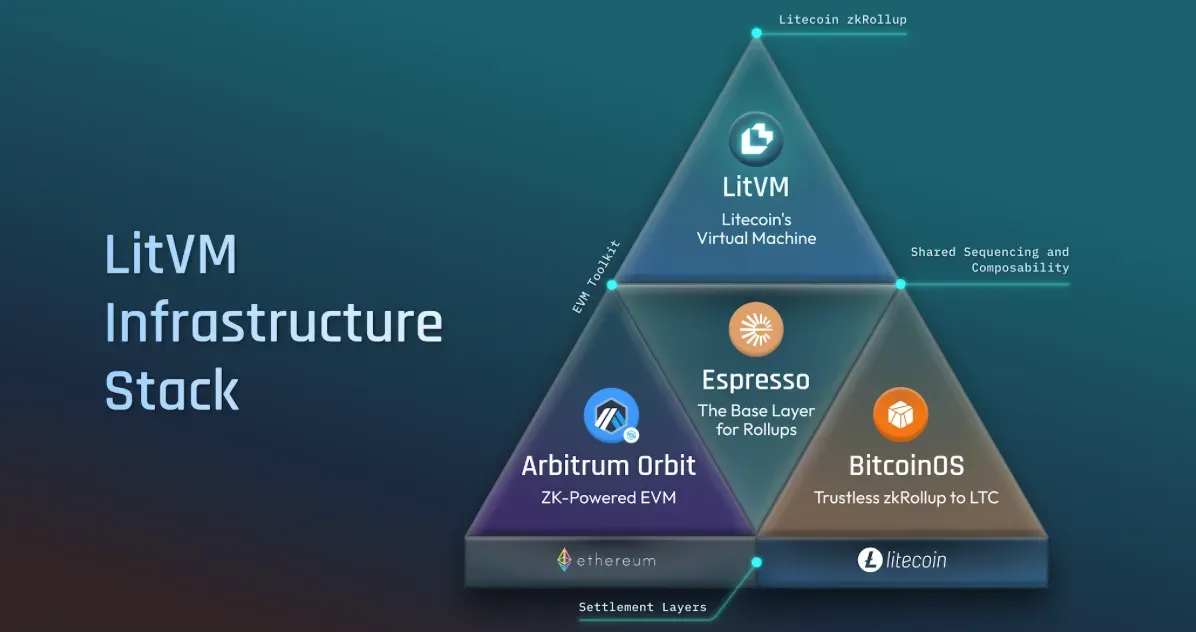
LitVM infrastructure stack
To further strengthen this, concise zkVM adds zero-knowledge proofs to the optimistic rollup base, creating a hybrid system where transactions achieve fast finality with optional cryptographic validation for cross-chain bridging. Bitcoin OSis an adaptation of Bitcoin’s origins, leveraging Litecoin’s Scrypt consensus to enable quick 2.5 minute settlements, trustless bridging and programmability.
of espresso A distributed sequencer further strengthens the setup by distributing block order across a network of nodes, ensuring censorship resistance and fair transaction inclusion through the HotShot consensus protocol.
Key components include:
- Scalability mechanism: Off-chain processing with zkSNARK for compact layer 1 verified proofs of Litecoin.
- Interoperability features: Dual payments on Ethereum for access to liquidity, combined with bridges to Bitcoin and other chains.
- Privacy integration: Based on Litecoin’s MimbleWimble to enable shielded transactions in compatible applications.
- Customization options: Use zkLTC as the native gas token and align costs with Litecoin economics.
This architecture not only maintains the integrity of Litecoin’s proof of work, but also opens the door to the EVM ecosystem, allowing for seamless developer migration and asset composability across the chain.
What is your deployment strategy and schedule?
LitVM deployment follows a phased approach to ensure stability and gradual integration with Litecoin mainnet.
Phase 1is known as.first light” includes the launch of the Arbitrum Orbit rollup, initially set up on top of Ethereum, complete with a trustless Litecoin bridge powered by BitcoinOS’ Grail framework. User can lock. LTC Mint zkLTC at the base layer for use as gas and base assets, enabling instant smart contract functionality without changing Litecoin consensus. Espresso handles distributed sequences from day one.
in Phase 2,”silver anchor”, completed batches and their zkVM proofs are fixed directly to Litecoin via an engraved cryptographic fingerprint, creating a verifiable history secured by Litecoin’s accumulated proof of work. This step strengthens sovereignty and allows for independent verification should Ethereum run into problems.
Phase 3,”Litecoin normalization” will move Litecoin into the primary payment layer once its reliability is proven. Through client upgrades, nodes will validate Litecoin headers, phase out dependencies on Ethereum, and derive finality from Litecoin’s hashing power. The entire process does not require a hard fork of Litecoin itself.
The timeline began with the announcement at. 2025 Litecoin Summitfollowed by a testnet launch scheduled for early 2026. Mainnet activation is expected shortly thereafter with continued community updates via platforms such as X, with recent posts highlighting ecosystem growth and engagement efforts.
How will LitVM evolve Litecoin use cases?
LitVM extends Litecoin’s traditional payments role into the versatile Web3 ecosystem by enabling programmable features. For example, decentralized finance supports trading. LTC automated market maker cross-chain assets, LTC-Nurturing DeFi hubs with institutional strategies through backed lending and stablecoin yield farming.
Real-world assets benefit from tokenization, where goods such as gold and real estate become fractionated ordinal or LRC20 tokens, managed by smart contracts and oracles for broader access.
AI integration is outstanding, enabling autonomous agents to process wallets, transact, and earn loyalty at low cost, and consumer-facing apps to simplify Web3 onboarding. Payments will evolve with programmable scripts for subscriptions and microtransactions, and will be enhanced with privacy options.
The game is LTC Rewards are earned and NFTs grow through marketplaces with royalties and cross-chain listings.
Recent data shows that Litecoin’s on-chain transaction volume will skyrocket from $8 billion to more than $22 billion daily by 2025, confirming the expansion of activity that LitVM can scale. By bridging with Ethereum and Bitcoin, we create opportunities for developers and users and encourage adoption through grants and hackathons.
conclusion
LitVM is an important step for Litecoin, addressing scalability and programmability while maintaining Litecoin’s core principles. Through a hybrid rollup design and gradual rollout, we position Litecoin as a competitive player in Web3, supporting diverse applications from DeFi to AI.
The ecosystem could expand further as testnet plans move forward in 2026 LTC Utility and community engagement could increase Litecoin’s long-term relevance in digital finance. Readers interested in participating can search official resources for the latest information on developments and incentives.
source:
- Litecoin VM on X: Announcements and ecosystem updates.
- LitVM website: General information and resources.
- LitVM Blog: “Introducing LitVM: Litecoin’s ZK Omnichain” (2025).
- LitVM Blog: “Birth of Sound Money Web3” (2025).
- globe news wire: “Litecoin’s ZK omnichain LitVM announced at Litecoin Summit” press release (2025).